What We Find to Be True
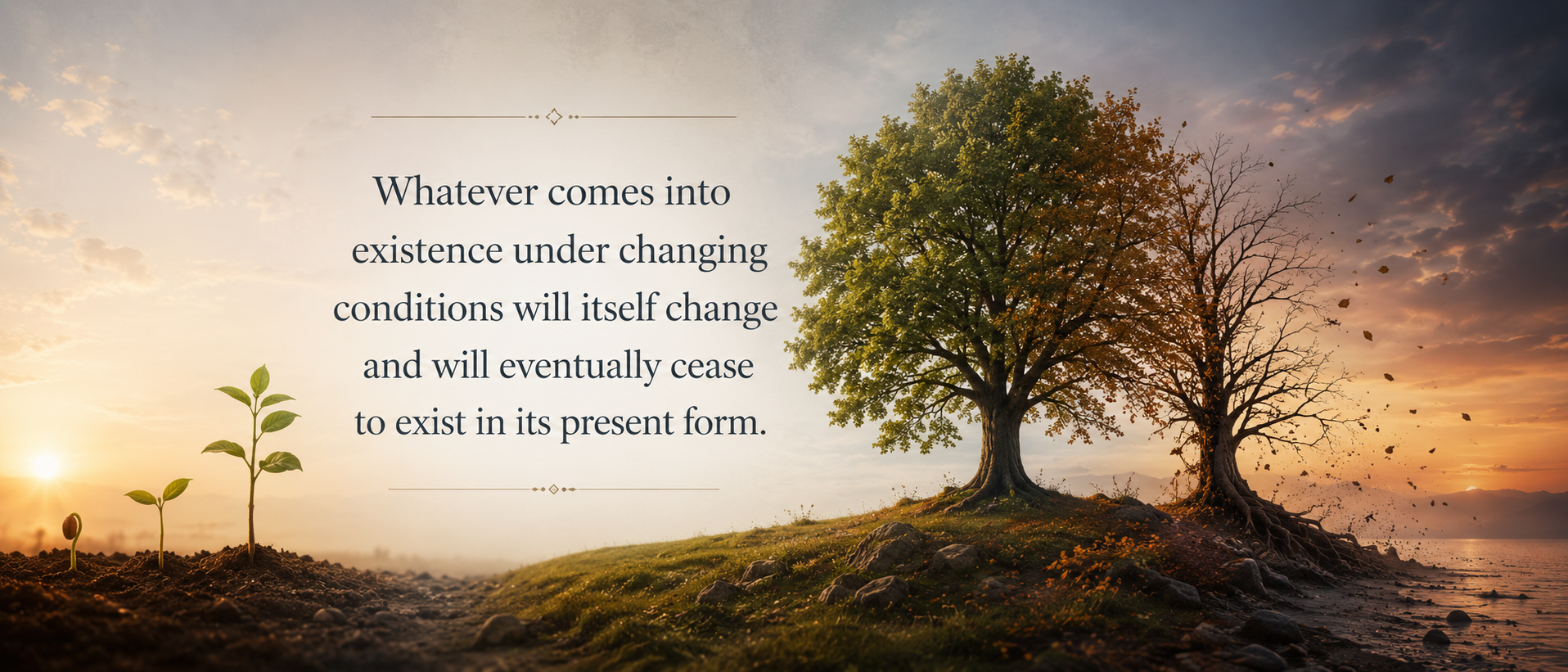
Whatever comes into existence under changing conditions will itself change and will eventually cease to exist in its present form.
Everything we can observe that comes into existence as an organised form undergoes change and eventually ceases to exist in that form, although its matter, energy, effects or influence may continue.
Evidence summary
The pattern can be observed throughout nature.
Every known living organism is subject to biological change and death. Physical objects are altered through weathering, corrosion, erosion, pressure, heat and chemical reactions. Stars and planetary systems change over immense periods. Human societies, political systems, businesses and cultures also arise, develop and eventually transform or disappear.
No confirmed example is known of a complex physical organism, object or institution that began to exist and then remained permanently unchanged.
Agreement Across Belief Systems
Many philosophical and religious traditions broadly concur that formed things are impermanent. Buddhism teaches that conditioned phenomena arise, change and pass away. Hindu traditions describe recurring cycles of creation, preservation and dissolution. Christianity, Judaism and Islam emphasise the mortality of human life and the temporary nature of earthly possessions and power. Stoic philosophy also teaches that all material things are subject to change, decay and loss.
These traditions differ greatly in their explanations of what, if anything, may endure beyond physical death, but they share a common observation: living beings, material forms and human institutions do not remain permanently unchanged.
Reasoning summary
Anything that exists within the physical universe is affected by conditions around it. It exchanges energy, experiences forces and exists within time.
Change may happen rapidly or so slowly that it appears absent during a human lifetime. Apparent permanence, however, is not the same as actual permanence.
A mountain may endure for millions of years, but it is still changing. A stone may appear motionless, yet its surface weathers and its atoms interact with their environment. A civilisation may seem stable for centuries, but its population, institutions, beliefs and material conditions continue to change.
Where there is dependence on changing conditions, permanent preservation of an identical form is extremely unlikely.
Important qualification
This finding does not establish as an absolute metaphysical fact that literally everything imaginable must die or disappear.
Some fundamental entities, laws or aspects of reality may not have “come into existence” in the ordinary meaning of the phrase. Matter and energy may be transformed rather than destroyed. It is also uncertain whether the universe itself had an absolute beginning or whether anything exists beyond the observable universe.
The finding therefore applies most confidently to formed, organised and identifiable things that arise under particular conditions.
Counterarguments
Some things appear permanent
Mountains, stars and ancient structures may last far longer than a human life. Long duration, however, does not demonstrate permanence. Observation shows that each continues to undergo change.
Matter and energy are not destroyed
This does not contradict the finding. The claim concerns the ending of organised forms, not necessarily the annihilation of their components.
Religious traditions may propose eternal beings or souls
Such claims may be meaningful within particular belief systems, but they have not been established through publicly verifiable evidence. They therefore cannot presently overturn the observable conclusion about physical and living forms.
Some abstract truths may be timeless
A mathematical relationship may not grow, decay or die in the same way as a biological organism. Abstract concepts therefore require separate treatment. This finding concerns things that arise as physical, biological, social or organised phenomena.
Ethical consequences
Recognising impermanence can change how we understand possession, status, relationships and life itself.
What we possess cannot be held forever. Institutions should not be assumed to be permanent merely because they are powerful today. Natural environments, cultures and freedoms can be lost when they are neglected. Life is limited, making time and conduct significant.
Impermanence does not make life meaningless. It may make life more valuable. A limited experience can matter precisely because it cannot be repeated indefinitely.
The fact that people and other living beings age and die strengthens the importance of reducing unnecessary suffering while they are alive. Every conscious being is vulnerable to injury, loss, fear and death.
Impermanence also places responsibility on present generations. Environments, institutions and knowledge can deteriorate. They survive only while conditions continue to support them.
Conclusion
Everything we can observe that comes into existence as an organised form undergoes change. Living things grow, age and die. Objects deteriorate or are transformed. Societies and institutions rise and fall. Stars and planets pass through stages of formation, development and eventual transformation.
This does not necessarily mean that everything disappears without leaving any trace. When something ends, its matter, energy, effects or influence may continue in another form.
A tree dies, but its material returns to the soil and atmosphere. A star may cease to exist in its previous state while leaving behind another astronomical object. A person dies, but their actions, genetic inheritance, creations and influence may continue to affect others.
What ends is usually not existence in every possible sense, but the particular organised form by which the thing was recognised.
Whatever comes into existence under changing conditions will itself change and will eventually cease to exist in its present form.