Agnosticism
The position that the existence or nature of gods, supernatural beings or ultimate reality is unknown, uncertain or perhaps not presently knowable.
View sectionReligions and belief systems
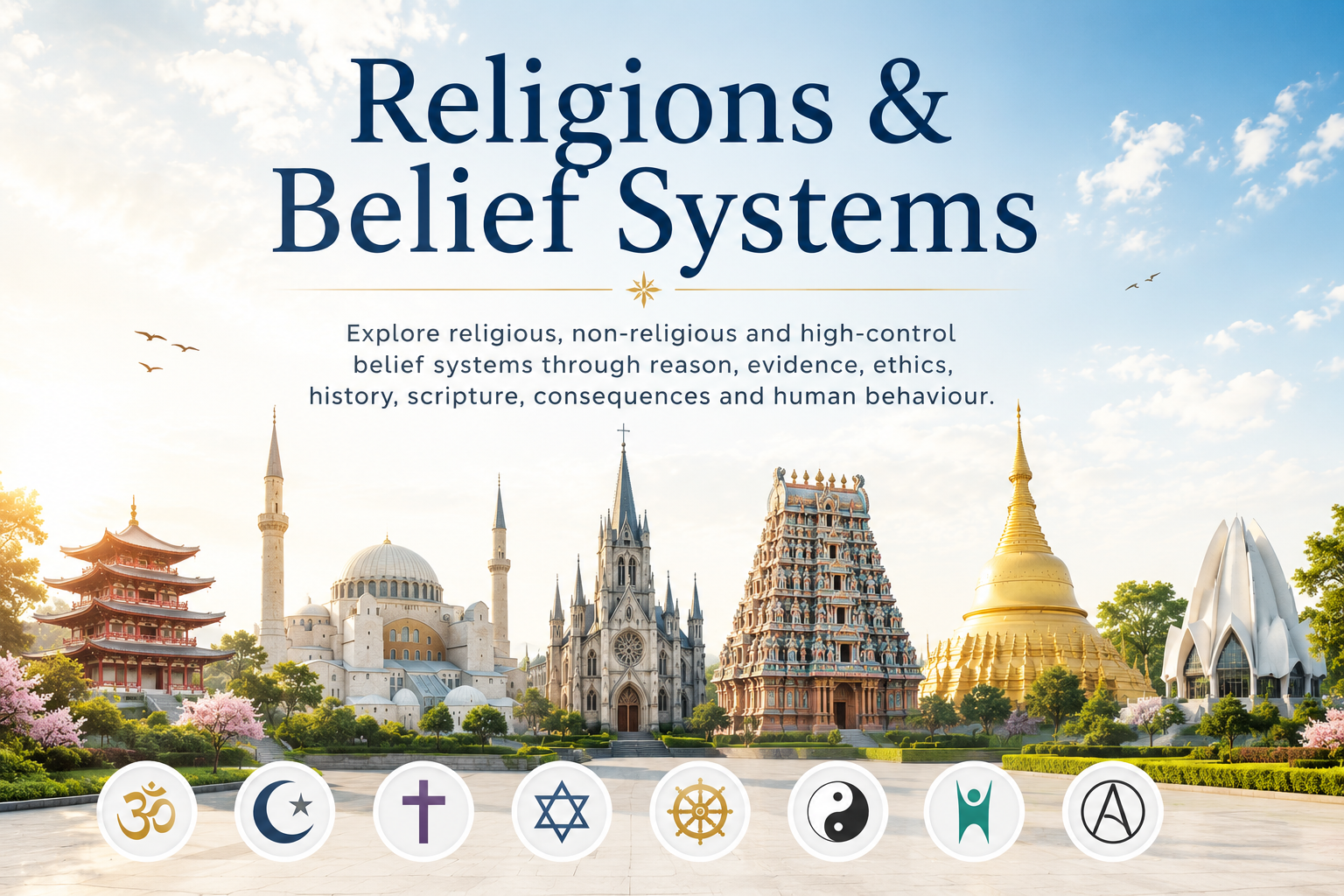
Explore religious, non-religious and high-control belief systems through reason, evidence, ethics, history, scripture, consequences and human behaviour.
The position that the existence or nature of gods, supernatural beings or ultimate reality is unknown, uncertain or perhaps not presently knowable.
View sectionDiverse spiritual, legal and cultural traditions of Anishinaabe peoples.
View sectionThe absence of belief in gods, or the positive conclusion that no gods exist, depending on how the term is being used.
View sectionA global religion founded in the nineteenth century by Bahá’u’lláh, emphasising the unity of humanity, progressive revelation, service, consultation and peaceful social development.
View sectionA diverse family of Indian-origin religious and philosophical traditions concerned with suffering, impermanence, conduct, meditation, wisdom, karma and liberation.
View sectionA Vietnamese syncretic religion established in the twentieth century.
View sectionA diverse monotheistic religion centred on Jesus of Nazareth, the Bible, worship of God and beliefs concerning salvation, resurrection and the meaning of Jesus's life and death.
View sectionA Chinese ethical, philosophical and religious tradition centred on moral cultivation, humane relationships, education, ritual, family responsibilities and government through virtue.
View sectionGroups or movements examined for coercive control, manipulation, authoritarian leadership, isolation, exploitation and restriction of members' freedom.
View sectionA Hellenistic philosophical tradition founded by Epicurus, emphasising freedom from disturbance, friendship, moderation and the rational examination of fear and desire.
View sectionA family of modern religious traditions drawing on pre-Christian Germanic and Norse sources, reconstructed through historical evidence and contemporary practice.
View sectionA broad family of Indian religious and philosophical traditions involving diverse concepts of divinity, duty, karma, rebirth, liberation, ritual, devotion and spiritual knowledge.
View sectionA monotheistic religion founded on belief in one God, the Qur'an as revelation to Muhammad, prophetic tradition, worship, moral responsibility and final judgement.
View sectionAn ancient Indian religious and philosophical tradition centred on nonviolence, truthfulness, non-attachment, self-discipline, karma and liberation from rebirth.
View sectionAn ancient and diverse religious and cultural tradition centred on the Jewish people, covenant, Torah, law, ethical responsibility, worship, history and communal life.
View sectionReligious and spiritual movements of relatively recent origin, including new organisations, teachings, revelations, communities and combinations of older traditions.
View sectionA broad umbrella for diverse modern religious traditions that may draw on pre-Christian religions, polytheism, nature reverence, seasonal observance, reconstruction, revival and contemporary spiritual practice.
View sectionThe philosophical tradition derived from Plato, including his accounts of knowledge, reality, Forms, the soul, virtue, justice, education and the Good.
View sectionThe Religious Society of Friends, a Christian tradition also known as Quakers.
View sectionA non-religious ethical and philosophical outlook grounded in human welfare, reason, evidence, individual freedom, equality and responsibility without reliance on supernatural authority.
View sectionThe diverse indigenous religious traditions of Japan, centred on kami, ritual purity, gratitude, place, community and seasonal observance.
View sectionA monotheistic religion founded in the Punjab through the teachings of Guru Nanak and the Sikh Gurus, emphasising devotion to one God, equality, honest work, service and remembrance of the divine.
View sectionA philosophical approach centred on disciplined questioning, intellectual humility, ethical self-examination and testing claims for contradiction.
View sectionAn ancient Greek and Roman philosophical tradition centred on reason, virtue, self-command, acceptance of what cannot be controlled, and living consistently with nature.
View sectionA Chinese philosophical and religious tradition centred on the Dao, naturalness, balance, simplicity, flexibility and acting without forced or excessive interference.
View sectionA Japanese religious tradition founded in the nineteenth century.
View sectionA modern non-theistic religious organisation using Satan as a symbol of resistance to arbitrary authority.
View sectionA non-creedal liberal religious tradition drawing from diverse sacred, secular and humanist sources.
View sectionA modern Pagan religion associated with reverence for nature, seasonal ritual, Goddess and God symbolism, ritual practice, magic and personal ethical responsibility.
View sectionAn ancient Iranian religious tradition associated with Zarathustra, Ahura Mazda and the moral struggle between truth and destructive falsehood.
View section