What Is Authoritarianism?
How concentrated and weakly accountable political power differs from democratic government
Read analysisFreedom
Evidence-based examination of authoritarian governments, dictatorship, transnational repression, censorship, surveillance, foreign interference and human-rights abuse.
This section distinguishes established facts, credible allegations, analysis, opinion and unresolved questions, while considering lawful, democratic and nonviolent responses.
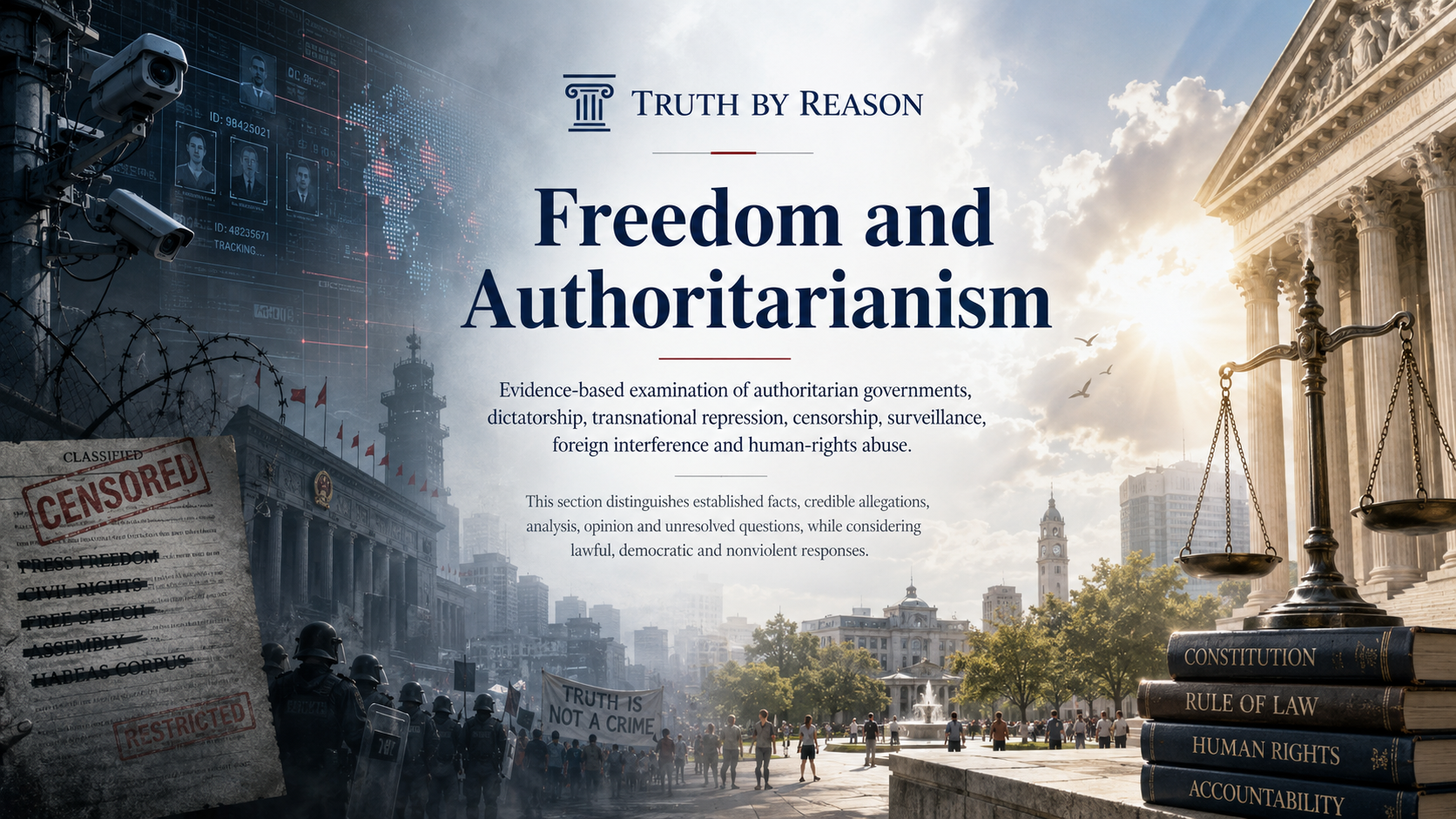
This section distinguishes established facts, credible allegations, analysis, opinion and unresolved questions. It supports lawful, democratic and nonviolent responses to abuse.
How concentrated and weakly accountable political power differs from democratic government
Read analysisHow governments reach across borders to intimidate, silence, control or punish people living abroad
Read analysisHow elected governments can gradually weaken courts, elections, media, civil society and the restraints on political power
Read analysisWhy the freedom to question, criticise, investigate and exchange ideas is essential to truth, human dignity and accountable government
Read analysisHow censorship, propaganda, surveillance, secrecy and media capture restrict what people can know and safely communicate
Read analysisWhy every person possesses fundamental rights regardless of nationality, belief, identity, status, popularity or political power
Read analysisWhy laws must bind rulers as well as citizens, be publicly known, equally applied and independently enforced
Read analysisWhy judges must be free from political pressure, corruption, intimidation and personal influence when deciding cases
Read analysisWhy genuine political choice requires more than placing a ballot into a box on election day
Read analysisWhy independent journalism, access to information and the safety of journalists are essential to freedom and accountable government
Read analysisWhy people must be free to organise political parties, unions, charities, campaigns, religious groups and other voluntary associations
Read analysisWhy people must be free to gather, protest, demonstrate, march and express collective views without unnecessary interference
Read analysisWhy every person must be free to hold, change, reject and practise religious or non-religious beliefs without coercion
Read analysisWhy people need protection for their personal lives, communications, homes, identities and information
Read analysisWhy justice requires independent courts, equal treatment, evidence, a genuine defence and decisions reached through fair procedures
Read analysisWhy no person should lose their liberty without lawful grounds, evidence, fair procedures and prompt independent review
Read analysisWhy no person may be tortured, abused, humiliated or subjected to inhuman or degrading treatment under any circumstances
Read analysisAn evidence-based examination of Communist Party rule, political power, elections, civil liberties and whether the description is justified
Read analysis