What We Find to Be True
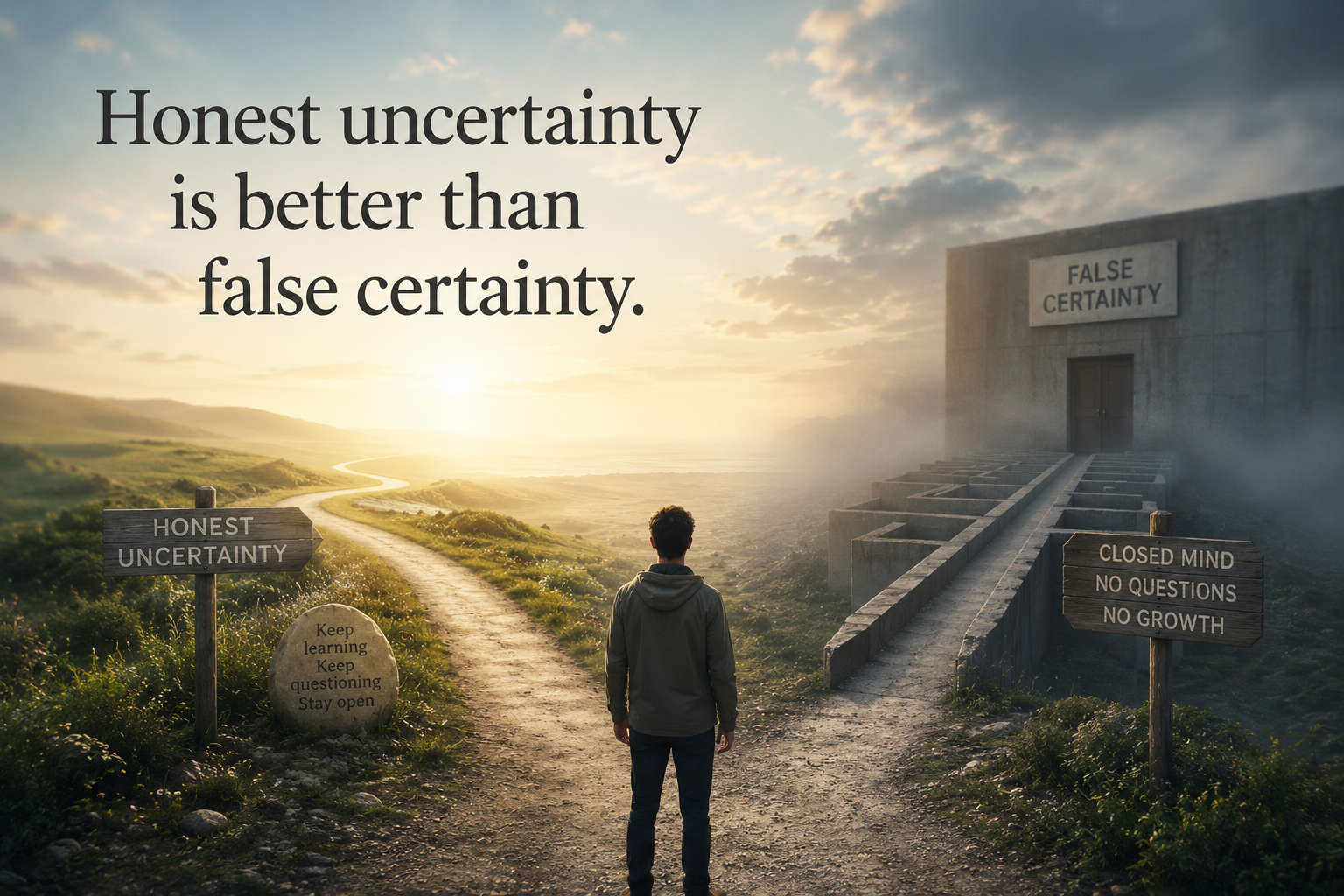
Honest uncertainty is better than false certainty.
When evidence is incomplete, unclear or conflicting, admitting uncertainty is more truthful and responsible than pretending to know.
Evidence summary
Many important questions involve incomplete evidence. Historical events may be partly documented. Religious claims may be impossible to verify directly. Political claims may be distorted by propaganda. Scientific questions may be under investigation. Personal memories may be sincere but unreliable. Ethical questions may involve competing values.
In such situations, certainty can be attractive. It feels strong, safe and decisive. It can give people identity, confidence and social belonging. But certainty that goes beyond the evidence is not a virtue. It can become a form of dishonesty, even when the person does not intend to deceive.
Honest uncertainty is common in responsible inquiry. Courts distinguish proof from suspicion. Science uses probability, confidence, error margins and revision. Historians distinguish established fact from interpretation. Ethical reasoning often works with uncertainty about consequences and competing harms.
Reasoning summary
Truth-seeking requires matching confidence to evidence. If evidence is strong, confidence may be strong. If evidence is weak, confidence should be lower. If evidence is absent or conflicting, uncertainty may be the most rational position.
False certainty blocks correction. A person who pretends to know may stop looking, stop listening, and stop revising. A person who admits uncertainty remains open to better evidence and better reasoning.
This does not mean every question must remain undecided forever. It means that the level of confidence should honestly reflect the available evidence. Sometimes the correct answer is yes. Sometimes no. Sometimes probably. Sometimes unlikely. Sometimes unknown.
Counterarguments
One counterargument is that people need certainty in order to act. Decisions often must be made without complete knowledge. This is true. Life, law, medicine, politics and personal responsibility often require action under uncertainty.
But action under uncertainty does not require false certainty. A person can say: the evidence is incomplete, but this is the most reasonable decision available at present. That is different from pretending that uncertainty does not exist.
Another counterargument is that too much uncertainty can become paralysis. This is also true. The answer is not endless doubt, but proportionate confidence. Honest uncertainty should help decision-making become more careful, not impossible.
Ethical consequences
False certainty can cause serious harm. It can support wrongful convictions, medical misinformation, religious dogmatism, political extremism, conspiracy thinking, war propaganda and personal arrogance.
Honest uncertainty encourages humility. It makes room for correction, dialogue, investigation and restraint. It also protects people from being pressured into claiming knowledge they do not actually possess.
Conclusion
Truth By Reason finds this to be a very strong practical truth: honest uncertainty is better than false certainty.
Where evidence does not justify certainty, the honest position is to say so. Truth-seeking is strengthened, not weakened, by admitting what is not yet known.