Freedom and Authoritarianism
Is China an Autocratic Dictatorship?
An evidence-based examination of Communist Party rule, political power, elections, civil liberties and whether the description is justified
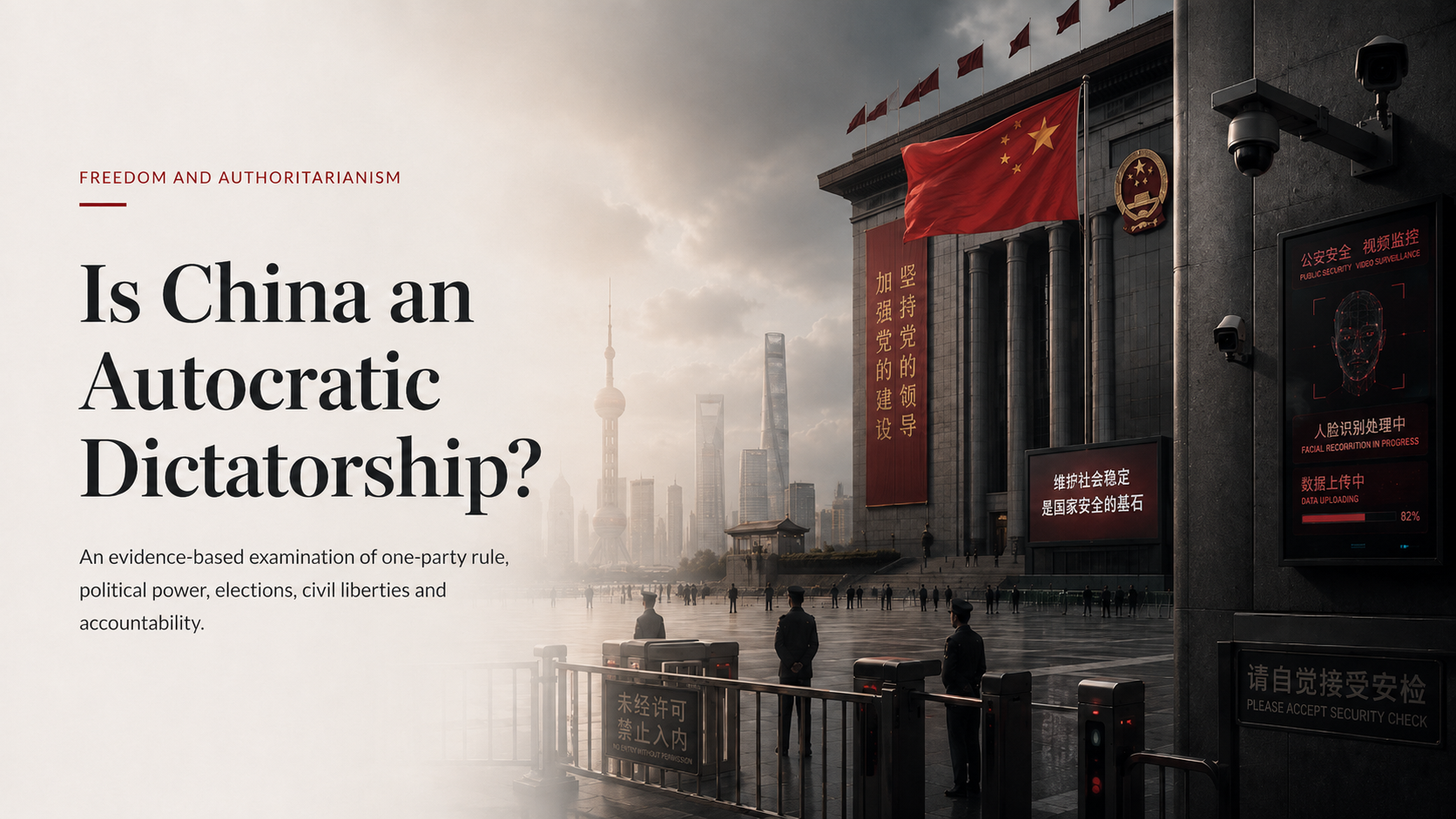
China is officially the People's Republic of China and describes itself as a socialist state under a people's democratic dictatorship.
Its constitution states that leadership by the Communist Party of China is the defining feature of socialism with Chinese characteristics. The Party exercises decisive authority over national political direction, senior appointments, the armed forces, security institutions and the state administration.
The question is therefore not whether China uses democratic language or maintains elections and representative bodies. The question is whether citizens can freely organise competing political parties, remove national leaders through genuinely competitive elections, criticise government without repression and rely upon institutions capable of constraining the ruling leadership.
Measured against ordinary political-science definitions, China is clearly autocratic. The word dictatorship is also defensible when used to describe concentrated, unaccountable one-party rule, although the term can be imprecise unless its meaning is explained.
Established facts
The following features of China's political system are well established:
- the Communist Party of China holds constitutionally recognised leadership over the political system;
- no opposition party can compete independently to replace the Communist Party as the national governing authority;
- China does not hold free, competitive national elections in which voters can remove the ruling party;
- senior state positions are determined through institutions controlled or directed by the Communist Party;
- the Party controls the People's Liberation Army through the Central Military Commission;
- independent political opposition is not legally permitted to organise as a genuine alternative government;
- major media organisations operate under extensive Party and state control;
- internet access, news, political discussion and online organisation are heavily censored and monitored;
- courts are not institutionally independent of Communist Party political leadership in the liberal-democratic sense;
- civil-society groups, religious organisations, lawyers, journalists and activists operate within restrictive political boundaries;
- Xi Jinping holds the positions of Communist Party general secretary, state president and chairman of the Central Military Commission;
- the constitutional two-term limit on the state presidency was removed in 2018.
Credible allegations
The material in this section is attributed and should not be treated as conclusively established unless stated otherwise.
Governments, researchers and human-rights organisations have alleged or documented numerous serious abuses connected with China's political system.
These include arbitrary detention, enforced disappearance, suppression of political opposition, censorship, mass surveillance, coercive treatment of ethnic and religious minorities, restrictions in Hong Kong, pressure upon journalists and lawyers, and punishment of peaceful critics.
Individual allegations vary in evidential strength and should be assessed separately. The broader classification of China's political system as authoritarian does not depend upon proving every disputed allegation.
Analysis
What does autocracy mean?
An autocracy is a political system in which effective power is concentrated in a ruler, ruling group or party and cannot be freely contested or removed through genuinely competitive democratic processes.
Autocracy does not require the absence of every election, legislature, court or consultation mechanism. It concerns who ultimately controls political authority and whether citizens can replace that authority peacefully and freely.
What does dictatorship mean?
Dictatorship commonly refers to government in which rulers exercise concentrated power without effective democratic accountability.
The term can describe personal rule by one leader, military rule, one-party rule or collective authoritarian leadership.
China is not simply a personal dictatorship in which every decision is made informally by one individual. It is a highly organised Leninist one-party state with extensive institutions, bureaucracy and internal Party procedures.
However, institutional complexity does not make the system democratically accountable to the public.
One-party political supremacy
The Communist Party is not merely one political organisation among several competitors. It is the central directing institution of the political system.
Other legally recognised parties participate through the system led by the Communist Party, but they do not function as opposition parties capable of campaigning to replace it.
This removes the central democratic possibility of an alternative government winning national power.
China's official description
China describes its system as socialist democracy, whole-process people's democracy and a people's democratic dictatorship.
Its official argument is that democracy should be judged by participation, consultation, development, social stability and whether government serves the people rather than only by multiparty elections.
This argument deserves accurate presentation. Political participation can take forms beyond national elections, and governments may obtain public support through performance, consultation and delivery of services.
However, these mechanisms do not give citizens an independent right to organise an alternative governing party or remove the Communist Party from national power.
National elections
China has elections at certain local levels and indirect selection processes leading to higher people's congresses.
The National People's Congress formally elects or appoints senior state officials and passes legislation.
But candidate selection, political organisation and higher-level appointments operate within Communist Party leadership.
Citizens cannot use national elections to choose between the Communist Party and a genuinely independent opposition government.
Peaceful transfer of power
A central test of democracy is whether incumbents can lose power and accept replacement by political opponents.
China has experienced leadership succession within the Communist Party, but not competitive transfer of national authority from the Communist Party to another political organisation.
Internal succession is not the same as public electoral accountability.
Concentration of power under Xi Jinping
Xi Jinping holds the leading offices of Party, state and military authority.
His period in power has been associated with increased centralisation, ideological discipline, personal political prominence and stronger Party control across government and society.
The removal of presidential term limits did not by itself create Chinese autocracy, because the presidency was never selected through a competitive national election.
It nevertheless removed one formal restraint and symbolised the weakening of earlier expectations concerning regular leadership succession.
The Party and the state
China has state institutions including ministries, courts, legislatures and local governments.
Alongside them operates a Communist Party structure capable of directing appointments and major policy.
Party committees are embedded throughout government, the military, state-owned organisations, universities and many private institutions.
The distinction between Party and state therefore does not create an independent separation capable of holding the Party politically accountable.
Judicial independence
Chinese courts resolve large numbers of civil, commercial and criminal cases and may exercise professional judgment in ordinary matters.
That does not mean the judiciary is independent of Communist Party leadership in politically sensitive cases.
A court system can possess technical competence while remaining subordinate on questions affecting ruling-party power.
Freedom of expression
Chinese citizens discuss many social, economic and personal matters, and criticism of local failures may sometimes be tolerated.
However, criticism challenging central Party authority, national leadership or politically sensitive official narratives faces censorship and possible punishment.
The boundary is not always fixed, which can encourage self-censorship.
Media freedom
Major news organisations operate under Party supervision and censorship requirements.
Journalism may expose corruption or local problems where authorised, but independent media cannot freely investigate every aspect of national political power.
A press that may criticise implementation but cannot independently challenge the legitimacy of the ruling system is not fully free.
Internet censorship and surveillance
China maintains an extensive system of website blocking, content removal, platform regulation, real-name requirements and surveillance.
Authorities defend these measures as necessary for security, social order, protection against harmful content and national sovereignty.
The same systems also restrict access to political information and make independent organisation more difficult.
Freedom of association
Independent political parties, national opposition organisations and autonomous trade unions are not allowed to compete freely for power.
Non-governmental organisations operate under registration, funding and political restrictions.
This prevents citizens from building durable institutions capable of challenging the ruling Party.
Freedom of assembly
Local protests over wages, land, housing or administrative grievances occur in China.
Authorities may sometimes respond through negotiation or correction.
Nationally coordinated movements or demonstrations challenging Party authority face much greater repression.
Political prisoners and detention
Critics, lawyers, journalists, religious figures and activists have been detained or prosecuted under offences involving national security, subversion, public order or state secrets.
The Chinese government maintains that its actions enforce law and protect security rather than punish legitimate expression.
Independent assessment requires examining whether alleged conduct involved violence or genuine criminal harm, or instead consisted mainly of peaceful criticism and organisation.
Hong Kong
Hong Kong historically retained institutions and civil liberties distinct from mainland China.
The national-security framework introduced since 2020 has substantially narrowed political opposition, protest, media freedom and civil society.
Supporters argue that the measures restored order after serious unrest. Critics argue that they dismantled meaningful political pluralism and autonomy.
Ethnic and religious minorities
China recognises ethnic groups and constitutionally refers to freedom of religious belief.
Religious organisations are nevertheless required to operate within state-approved structures and political limits.
Policies in Xinjiang and Tibet have attracted particularly serious allegations concerning surveillance, detention, coercive assimilation, religious repression and cultural control.
The Chinese government rejects many international accusations and describes its policies as counterterrorism, development, education and protection of national unity.
Government performance and legitimacy
China has achieved major economic growth, infrastructure development, technological advancement, poverty reduction and expanded state capacity.
These achievements may generate genuine public approval and national pride.
Government effectiveness and popularity are relevant to legitimacy, but they do not by themselves establish democracy.
A popular government can remain autocratic where citizens cannot freely remove it or organise an alternative.
Does public support disprove dictatorship?
No. An authoritarian government may possess substantial public support.
Support may arise from economic performance, nationalism, stability, social policy, education, media influence or fear of disorder.
It is also difficult to measure political opinion accurately where criticism carries risk and media environments are controlled.
Is every Chinese decision controlled by Xi Jinping?
No. China is too large and administratively complex for every decision to come from one individual.
Officials, ministries, provinces, experts and Party bodies all influence implementation and policy.
Dictatorship does not require personal management of every administrative act. It concerns the absence of effective public accountability at the highest level.
Is China totalitarian?
Totalitarianism generally describes an ambition to control politics, ideology, information and much of social life comprehensively.
China exercises extensive control but also contains markets, private life, internal debate, professional administration and areas of limited social autonomy.
Some analysts therefore prefer authoritarian, closed autocracy, one-party dictatorship or Leninist party-state rather than applying the most absolute form of the word totalitarian.
The most accurate description
The most precise concise description is that China is an authoritarian one-party state or closed autocracy governed by the Communist Party of China.
Calling it an autocratic dictatorship is substantially justified where dictatorship means concentrated rule without competitive electoral accountability.
The phrase should not imply that China lacks institutions, internal policy debate, legal procedures, popular support or administrative complexity.
Counterarguments and alternative explanations
China argues that Western electoral democracy is not the only form of democracy
This is a serious argument rather than one that should simply be dismissed.
Elections alone do not guarantee competent, representative or ethical government. Democracies may suffer corruption, manipulation, inequality and short-term decision-making.
However, the defects of electoral democracy do not establish that a system without competitive national political choice is democratic.
China consults the population and responds to public needs
Consultation, surveys, local participation, complaint systems and policy experimentation can provide meaningful information and influence.
These mechanisms may make government more responsive.
They still operate within boundaries set by the ruling Party and do not allow citizens to replace it.
China has several political parties
China recognises eight minor parties in addition to the Communist Party.
They participate in consultation and cooperation under Communist Party leadership.
They are not opposition parties competing independently to form a national government, so their existence does not create multiparty electoral competition.
The National People's Congress is constitutionally the highest state organ
Formally, the National People's Congress exercises major legislative and appointment powers.
The relevant question is whether it operates independently enough to reject ruling-party direction and remove national leadership through autonomous political competition.
Its legal status does not by itself prove democratic independence.
China has lifted hundreds of millions from poverty
China's economic and developmental achievements are highly significant.
They show that authoritarian systems can sometimes deliver growth and effective administration.
They do not answer whether citizens possess political rights, independent institutions or the ability to replace rulers.
Many Chinese citizens support the government
This may be true, and support should not be dismissed as entirely manufactured.
But democracy requires more than approval. It requires the freedom to oppose, organise, obtain independent information and attempt to remove incumbents.
Western governments also censor, surveil and abuse power
Democratic states can violate rights and act hypocritically.
Those failures should be investigated and criticised.
They do not alter the institutional question of whether China permits competitive national government, free opposition and independent accountability.
The word dictatorship is emotionally loaded
Yes. The term is often used as an insult rather than an analytical category.
For accuracy, it is better to explain the specific institutions and evidence first.
The conclusion should follow from those facts rather than from hostility toward China, Chinese people or Chinese culture.
Unknowns and evidence gaps
The true level of private public support for the Communist Party is difficult to measure in a restricted political environment.
China's internal decision-making is not fully transparent, and the relative influence of Xi Jinping, senior Party bodies, ministries, provincial leaders and security institutions can be difficult to determine from outside.
Reliable assessment of conditions in politically sensitive regions is limited by restricted access, censorship and competing official and activist narratives.
China's future political development is uncertain. Centralised rule may remain stable, become more personalised, experience internal reform or face pressures that are not presently predictable.
These uncertainties affect the details of analysis but do not alter the established absence of competitive national electoral accountability.
Human-rights consequences
The consequences of China's authoritarian political structure may include:
- no lawful route for an opposition party to replace the Communist Party nationally;
- censorship and restricted access to political information;
- surveillance of citizens, journalists, activists and minority communities;
- punishment of peaceful political organisation and criticism;
- limited judicial independence in politically sensitive cases;
- weak public accountability for senior leadership decisions;
- restrictions upon independent unions, civil society and religious organisations;
- risk of arbitrary detention under broad security offences;
- reduced ability to investigate official misconduct independently;
- pressure upon Hong Kong's political and civic institutions;
- serious risks for ethnic, religious and regional minorities;
- self-censorship caused by uncertain political boundaries.
These consequences should be analysed without treating Chinese citizens as responsible for the actions of their government or ruling party.
Lawful responses and reform
Lawful and constructive responses include:
- using accurate language and distinguishing China's government from its people;
- supporting independent evidence, journalism and academic research;
- documenting specific abuses rather than relying upon slogans;
- protecting Chinese dissidents, journalists and exiles from transnational repression;
- supporting freedom of expression, religion, association and peaceful assembly;
- calling for fair trials and protection against arbitrary detention and torture;
- using targeted legal and diplomatic measures rather than hostility toward ordinary citizens;
- requiring businesses to assess surveillance, forced-labour and human-rights risks;
- maintaining dialogue on trade, climate, security and global problems where cooperation is necessary;
- avoiding racism, collective blame and anti-Chinese prejudice;
- allowing factual correction and genuine Chinese government responses to allegations;
- distinguishing criticism of Communist Party rule from hostility toward China as a country or civilisation.
Conclusion
China is an autocracy under the ordinary political-science meaning of the term.
Effective national power is controlled by the Communist Party of China. Citizens cannot organise an independent opposition party capable of replacing it through free and competitive national elections.
Political expression, media, association, civil society, courts and digital communication operate within limits ultimately enforced by the Party-state.
The description autocratic dictatorship is therefore justified if dictatorship is understood as concentrated one-party rule without effective democratic accountability.
The more precise description is an authoritarian one-party state, a closed autocracy or a Leninist party-state.
This conclusion does not deny China's institutional complexity, development achievements, administrative capacity, internal consultation or genuine public support. Those facts are compatible with authoritarian government.
Criticism should remain directed at evidence, institutions and conduct—not at Chinese people, ethnicity or culture.
Right of reply
Truth By Reason welcomes factual corrections and substantive responses from Chinese government institutions, scholars, affected individuals and other informed parties. Responses should address the evidence and institutional analysis presented in this article.
Related findings
Sources used
- China: Freedom in the World 2026 Country Report high
- China: Freedom on the Net 2025 Country Report high
- Constitution of the Communist Party of China Official source
- Constitution of the People's Republic of China Official source
- Democracy Report 2026 high
- Resolution of the CPC Central Committee on the Major Achievements and Historical Experience of the Party over the Past Century Official source