Freedom and Authoritarianism
Why Protection from Arbitrary Arrest and Detention Matters
Why no person should lose their liberty without lawful grounds, evidence, fair procedures and prompt independent review
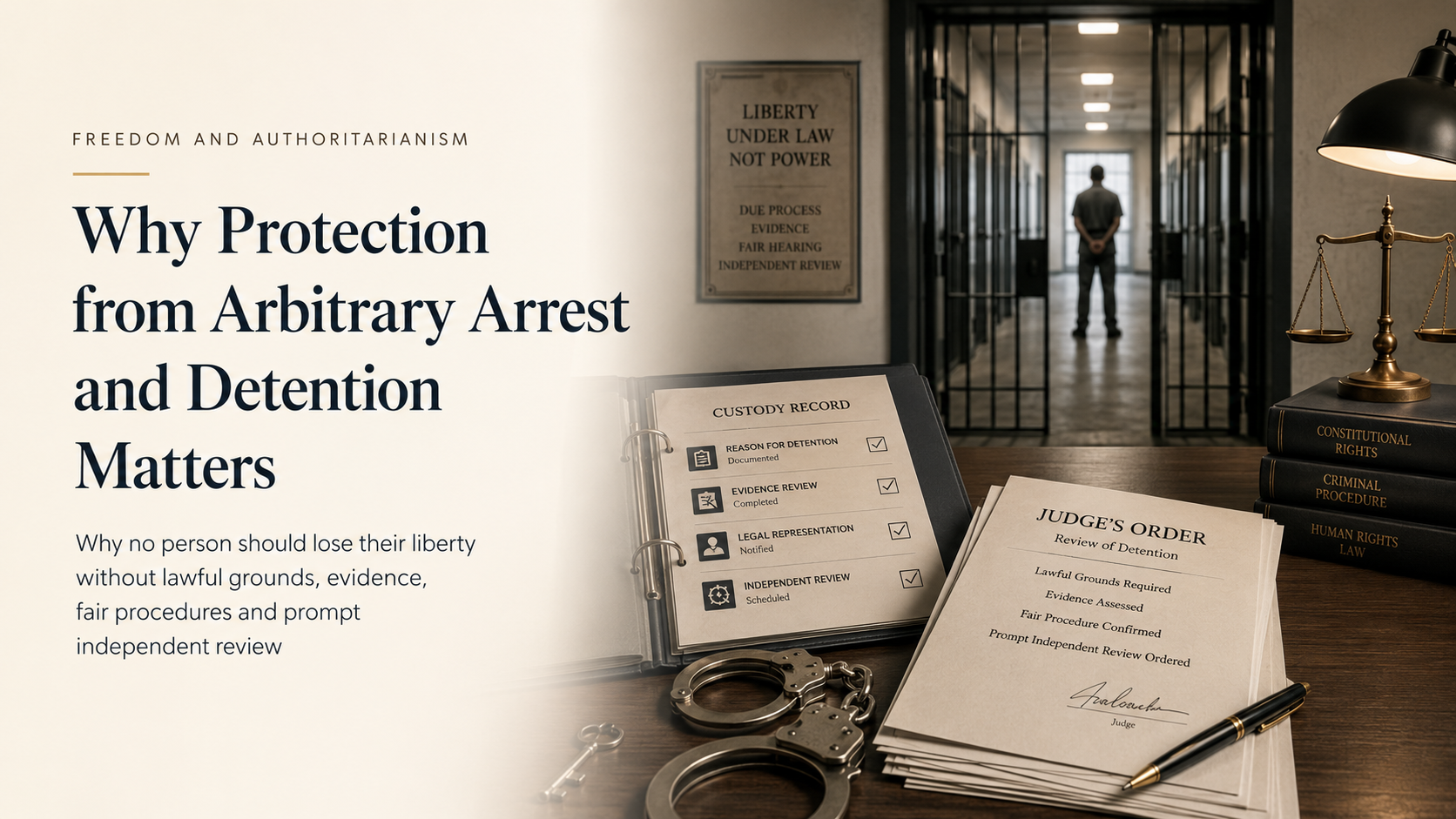
Protection from arbitrary arrest and detention means that no person should be deprived of liberty merely because a government, official or powerful institution wishes to silence, punish or control them.
Arrest and detention may sometimes be lawful and necessary. A person suspected of a genuine offence may be arrested, a court may impose imprisonment after conviction, and limited detention may be used in other carefully defined circumstances.
But taking away liberty is among the most serious powers a state can exercise. It must therefore be based upon clear law, legitimate grounds, evidence, fair procedure and prompt review by an independent court.
Where authorities can imprison people without meaningful justification or challenge, every other freedom becomes insecure.
Established facts
Widely recognised safeguards against arbitrary arrest and detention include:
- Lawful grounds: detention must be authorised by clear and accessible law.
- Freedom from arbitrariness: legality alone is insufficient where detention is unjust, unpredictable, unnecessary or disproportionate.
- Prompt reasons: an arrested person must be told why liberty is being taken away.
- Prompt charges: anyone arrested on suspicion of crime must be informed of the accusation.
- Judicial control: detention must be brought promptly before an independent judicial authority.
- Ability to challenge detention: every detained person must be able to seek release through a court.
- Trial within a reasonable time or release: pre-trial detention must not become punishment without conviction.
- Presumption in favour of liberty: detention before trial should not be automatic.
- Access to a lawyer: legal assistance is essential for challenging unlawful detention.
- Notification of family: people should not disappear into unrecorded custody.
- Official records: authorities should record the place, time, grounds and responsible officials.
- Humane treatment: every detained person retains human dignity and other fundamental rights.
- Compensation: victims of unlawful arrest or detention should have an enforceable remedy.
Protection applies to criminal detention and may also apply to immigration detention, psychiatric confinement, military custody, protective detention and other forms of state-controlled confinement.
Analysis
Liberty is the starting point
Personal liberty allows people to move, work, maintain relationships, participate in society and exercise other rights.
Detention reverses this position by placing the person under direct state control.
Because the consequences are severe, the state should bear the burden of showing why detention is lawful and necessary.
Lawful detention can still be arbitrary
A government may pass legislation allowing detention while still acting arbitrarily.
A law might be vague, discriminatory, grossly disproportionate or designed to imprison peaceful opponents.
Protection against arbitrariness therefore requires more than technical compliance with domestic legislation. It requires reasonableness, necessity, proportionality and fairness.
Reasons for arrest
A person cannot challenge detention without knowing why it occurred.
Reasons should be specific enough to explain the legal and factual basis, not merely repeat a vague phrase such as public order or national security.
Prompt information also allows lawyers and courts to identify mistaken identity, lack of evidence or abuse of authority.
Prompt judicial review
Police, intelligence agencies, military officers and executive officials should not have final authority over detention.
An independent judicial authority must be able to examine the grounds, evidence and procedure and order release where detention is unlawful or arbitrary.
Review must be practical and timely. A hearing after weeks or months may come too late to prevent serious harm.
Habeas corpus and equivalent remedies
Legal systems use different names for the right to challenge detention. The essential principle is that a court must be able to require the authorities to produce the detained person and justify continued confinement.
This protection is especially important where a person is held secretly, transferred between facilities or denied contact with family and lawyers.
Pre-trial detention
A person awaiting trial remains legally presumed innocent.
Pre-trial detention may sometimes be justified by a real risk of flight, interference with evidence, harm to others or serious obstruction of proceedings.
It should not be automatic merely because an offence carries a serious penalty.
Courts should consider less restrictive measures such as reporting conditions, bail, travel restrictions or supervision.
Length of detention
Detention that was initially justified may become arbitrary when it continues too long without adequate review.
Authorities must act diligently and explain why continued confinement remains necessary.
Repeated use of identical or formulaic reasons does not demonstrate genuine individual assessment.
Secret and unacknowledged detention
When authorities refuse to acknowledge custody or conceal a person's location, the risk of torture, disappearance and death increases substantially.
All detention should occur in officially recognised locations and be recorded accurately.
Families, lawyers and monitoring bodies must have lawful means of establishing where a person is held.
Access to legal counsel
A detained person is placed in a position of extreme dependence upon the authorities.
Prompt access to a lawyer protects against coercion, explains legal rights, enables challenges and helps preserve evidence of mistreatment.
Lawyer-client communication should remain confidential except in narrowly defined and independently supervised circumstances.
Family notification
Notification reduces the danger that a person will disappear within the detention system.
Temporary delay may occasionally be justified by a specific investigative risk, but it should be exceptional and subject to safeguards.
Authorities should record the person's location and permit reasonable communication.
Detention records
Reliable custody records should identify the detained person, grounds, time of arrest, location, responsible officers, transfers, medical condition and release.
Missing or altered records make accountability difficult and create opportunities for abuse.
Independent inspectors and courts should be able to examine those records.
Immigration detention
States may control entry and removal, but immigration status does not remove the right to liberty.
Detention should serve a legitimate purpose, remain necessary and be reviewed individually.
It should not continue where removal is not realistically possible or where less restrictive arrangements would be effective.
Children
Detention can cause especially serious harm to children.
It should be used only as a measure of last resort and for the shortest appropriate period.
The child's best interests, development, family relationships and access to education and care require particular protection.
Psychiatric detention
Serious mental-health crises may sometimes require protective intervention.
Diagnosis alone should not justify indefinite or automatic confinement.
Detention should depend upon lawful criteria, current evidence, necessity, appropriate care and regular independent review.
Preventive and security detention
Governments may seek to detain people to prevent anticipated threats rather than prosecute completed offences.
Such powers carry exceptional risks because they rely upon predictions, intelligence and material that may remain secret.
Strong judicial control, access to the substance of the case and strict time limits are necessary.
Emergency powers
War, terrorism, unrest or disaster may create genuine threats.
Emergency conditions do not make every detention lawful.
Powers should remain temporary, necessary, proportionate, reviewable and protected against discrimination and political misuse.
Detention for peaceful expression
Imprisoning people for peaceful criticism, journalism, religious belief, association or protest transforms detention into a tool of repression.
Authorities may describe peaceful opponents as extremists, threats or enemies without demonstrating criminal conduct.
Courts should examine evidence and actual behaviour rather than accepting political labels.
Administrative detention
Administrative systems may permit confinement without ordinary criminal trial.
They may be used for immigration, security, public health or other regulatory purposes.
Because they bypass normal criminal safeguards, they require clear limits, independent review and a genuine continuing justification.
Bail and financial inequality
Bail systems can create unequal detention where poor defendants remain imprisoned solely because they cannot pay.
Release decisions should focus upon actual risk rather than wealth.
Financial conditions should be proportionate and accompanied by non-financial alternatives.
Conditions of detention
A detention may have lawful grounds while the conditions violate other rights.
Overcrowding, denial of healthcare, violence, isolation and inadequate food can become cruel or degrading treatment.
Judicial review and independent inspection should consider the practical reality of confinement.
Compensation and accountability
Release alone may not repair lost employment, damaged health, family separation and reputational harm.
Victims require effective remedies, which may include compensation, correction of records, investigation and accountability for responsible officials.
Why authoritarian governments rely on detention
Arbitrary detention removes critics from public life and frightens others without requiring open political debate.
Short repeated arrests, travel detention, psychiatric confinement and administrative custody may suppress opposition while avoiding highly visible long prison sentences.
The threat of detention can therefore control many more people than those physically imprisoned.
Counterarguments and alternative explanations
Does public safety require broad detention powers?
Governments need powers to arrest genuine suspects and prevent serious harm.
Broad authority without evidence or review also creates opportunities for error, discrimination and political abuse.
Effective security depends upon targeted, lawful powers rather than unlimited discretion.
Can dangerous suspects be released before trial?
Some suspects present a genuine risk of violence, flight or interference with evidence.
Pre-trial detention may be justified in those cases.
The decision should be individual, evidence-based and regularly reviewed rather than automatic for an entire category of accused people.
Can secret evidence justify detention?
Security investigations may involve confidential sources and sensitive methods.
Complete secrecy prevents meaningful challenge and increases the risk of mistake.
Courts should use the least restrictive safeguards available while ensuring that the detained person can understand and contest the essential allegations.
Should immigration detention be automatic?
States may need temporary custody to establish identity or arrange lawful removal.
Automatic detention ignores differences between individuals and may continue where no real removal prospect exists.
Individual assessment and alternatives should therefore be considered.
Does judicial review interfere with police work?
Prompt review may require authorities to explain decisions while an investigation continues.
This is not an improper obstacle. It is a safeguard ensuring that coercive power remains lawful.
Judges may protect legitimate investigative needs without abandoning independent scrutiny.
Can emergency threats justify indefinite detention?
Indefinite detention without charge creates severe risks of abuse and error.
Where a person is suspected of serious wrongdoing, authorities should normally investigate and prosecute through fair proceedings.
Exceptional preventive measures require strict limits and repeated independent review.
Unknowns and evidence gaps
Legal systems differ over permissible detention periods, bail rules, immigration custody and the use of preventive security measures.
There is continuing debate over how classified intelligence can be tested without exposing genuine security sources.
Predictive technology and automated risk assessments may influence decisions concerning arrest, bail and release while concealing bias or error.
Public-health emergencies may raise difficult questions about quarantine, compulsory treatment and individual liberty.
States also differ in the safeguards governing psychiatric detention and protective custody.
These disagreements require continuing assessment of evidence, necessity, proportionality and the availability of less restrictive alternatives.
Human-rights consequences
When protection from arbitrary detention is weakened, consequences may include:
- imprisonment of political opponents and journalists;
- detention without known charges;
- secret or unacknowledged custody;
- enforced disappearance;
- torture and coerced confession;
- indefinite pre-trial detention;
- detention based upon religion, ethnicity or political belief;
- automatic immigration confinement;
- detention of children without necessity;
- denial of lawyers, family contact and medical care;
- financial detention of people unable to afford bail;
- fear and self-censorship throughout society.
The ability to imprison without meaningful review gives authorities direct control over the physical freedom of every person.
Lawful responses and reform
Measures protecting liberty and security include:
- defining grounds for arrest and detention clearly in law;
- requiring prompt and specific reasons for every arrest;
- informing criminal suspects promptly of charges;
- bringing detained people promptly before an independent judge;
- providing an effective procedure to challenge detention;
- ensuring confidential access to legal counsel;
- notifying family or another chosen person promptly;
- maintaining accurate and accessible detention records;
- using officially recognised places of detention only;
- presuming release before trial unless specific risks are shown;
- considering bail and non-custodial alternatives;
- reviewing detention regularly and individually;
- protecting children through last-resort and shortest-time rules;
- allowing independent inspection of detention facilities;
- investigating secret detention, disappearance and mistreatment;
- providing compensation and remedies for unlawful detention.
Authorities should be required to demonstrate the continuing necessity of detention rather than placing the burden entirely upon the detained person.
Conclusion
Protection from arbitrary arrest and detention ensures that no person loses liberty merely because an authority wishes to control, punish or silence them.
Detention may be lawful in defined circumstances, but it must rest upon legitimate grounds, clear procedure, evidence and prompt independent review.
Domestic legal authority alone is not enough where detention remains unjust, unnecessary, discriminatory or disproportionate.
Every detained person must know the reasons, have access to legal assistance and be able to ask a court to order release.
When government can imprison without meaningful justification or challenge, courts, elections, expression and every other freedom become vulnerable to coercion.
Related findings
Sources used
- About Arbitrary Detention Official source
- European Convention on Human Rights Official source
- General Comment No. 35: Article 9, Liberty and Security of Person Official source
- Guide on Article 5 of the European Convention on Human Rights Official source
- International Covenant on Civil and Political Rights Official source
- Working Group on Arbitrary Detention Official source